Learn Mandarin Chinese.
There is no conjugation, no gender and no plurals. There are characters and tones.
What actually stops people
The grammar is genuinely simpler than most European languages. Verbs do not change. Nouns do not change. This surprises people who were expecting the hard part to be there.
The hard part is the characters, which carry meaning without carrying sound, so unlike Japanese kana or Korean hangul there is no alphabet underneath to fall back on.
And tones, which are not an accent. mā and mà are different words, and a sentence said flat is not a slightly wrong sentence, it is a different one.
What happens here instead
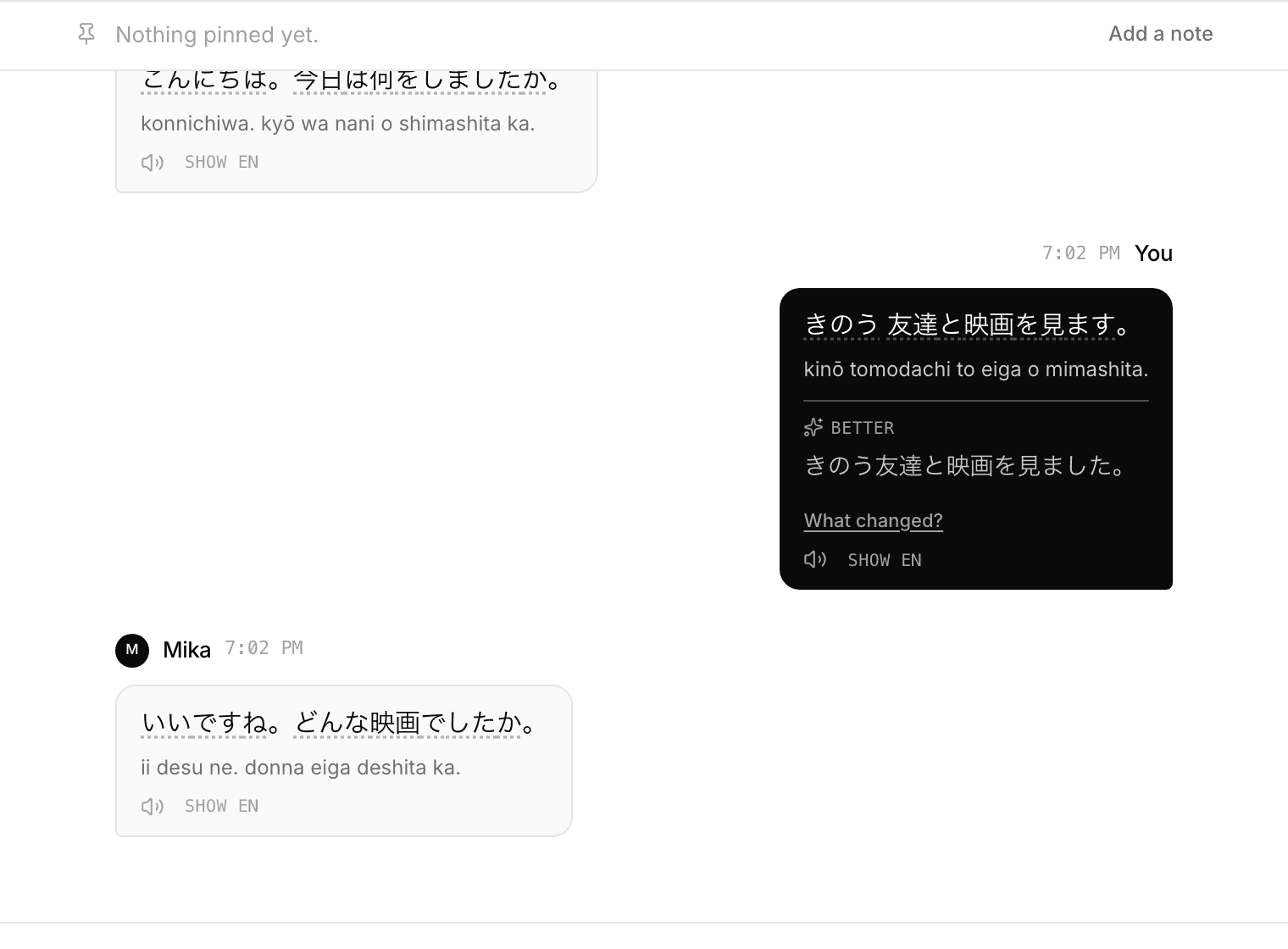
Every message shows pinyin with the tone marks, so the tone is visible on the page rather than something you were supposed to have heard. You can read a sentence correctly before you can read one character of it.
Tapping a character tells you what it means in that sentence, which matters more in Chinese than anywhere else: the same character is a different word depending on what it is next to.
Words you tap come back on a schedule, with their pronunciation and a button that reads them aloud, because a tone you have only seen written is a tone you have not learned.
Under any correction you can ask what changed, and it names what was wrong and the rule to remember, in the language you read rather than the one you are learning.
Starting
- Choose Learn and pick Chinese. The button above does both.
- Read the pinyin line and say it with the tones, out loud, even alone.
- Tap every character you do not recognise. The list builds itself and comes back to you.