Talking with family who speak another language
A relative who never learned your language, or whose language you never learned. Neither of you has to fix that to have a conversation this evening.
The whole thing
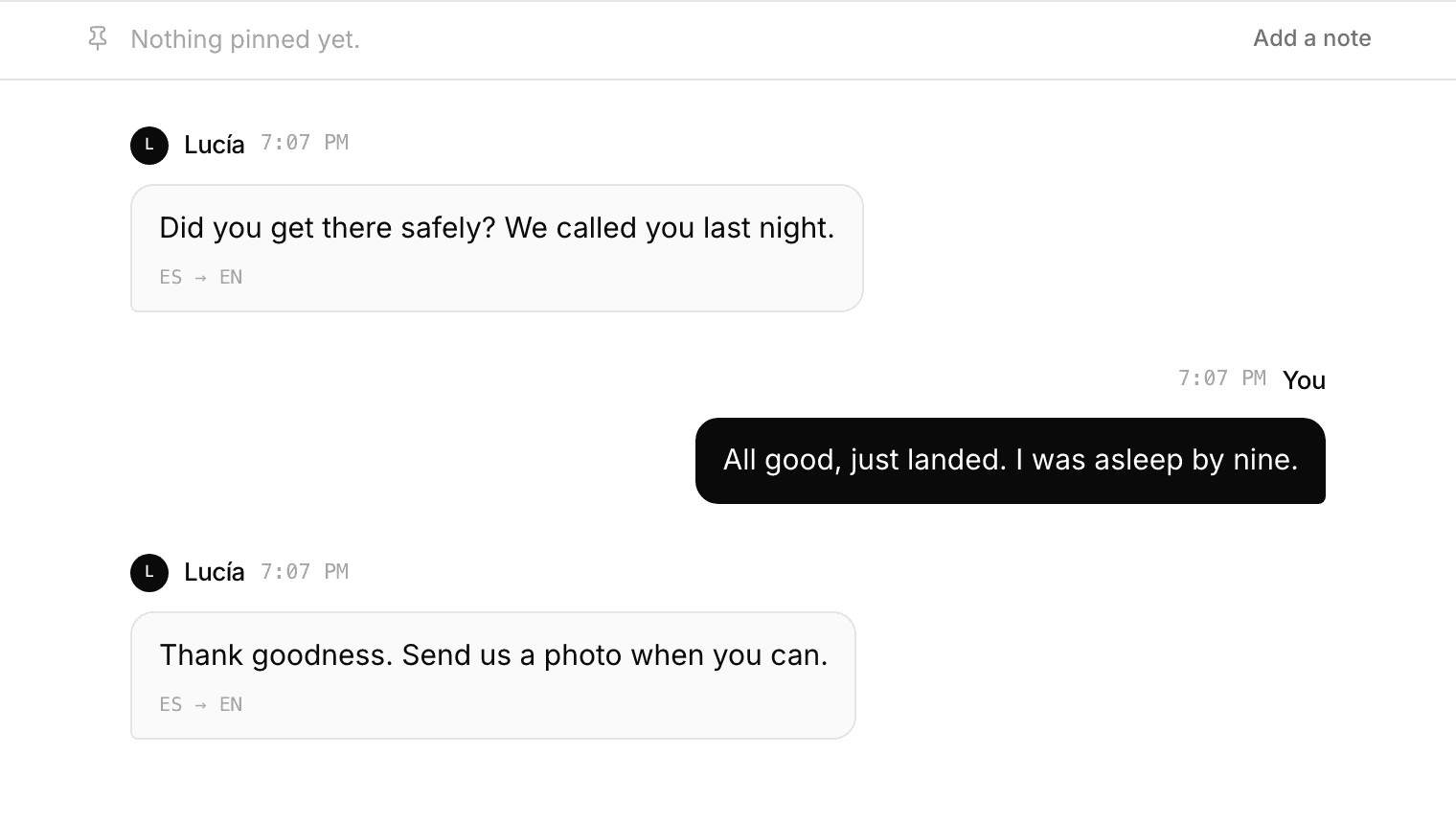
Start a room, send the link, and they pick the language they read in when they arrive. Then you both write normally and both read normally.
No account on either side, nothing to install, and it works on whatever phone they already have. If they are in the room with you, a QR code is faster than a link.
It keeps the conversation
Sign in and keep the room and it stays at the same link, so next week picks up where this week stopped rather than starting again.
Change the language you read in and everything already said follows you into it, so somebody joining an hour late can read all of it.
Seeing what they actually wrote
Every message can show the original underneath the translation. When a line reads oddly, that is usually the translation rather than the person, and one tap tells you which.
It matters most with the short ones. A joke, a nickname or a place name is where a translation goes wrong, and where seeing the words they chose settles it.
What an account changes, and what it does not
Nothing on their side. They never make one, and never see anything asking them to.
On yours it is worth one: signing in keeps the room at the same link, raises what it can hold from 150 messages to 5,000, and puts it on a list so you are not hunting for a code. Signing in is a link sent to your address, with no password.